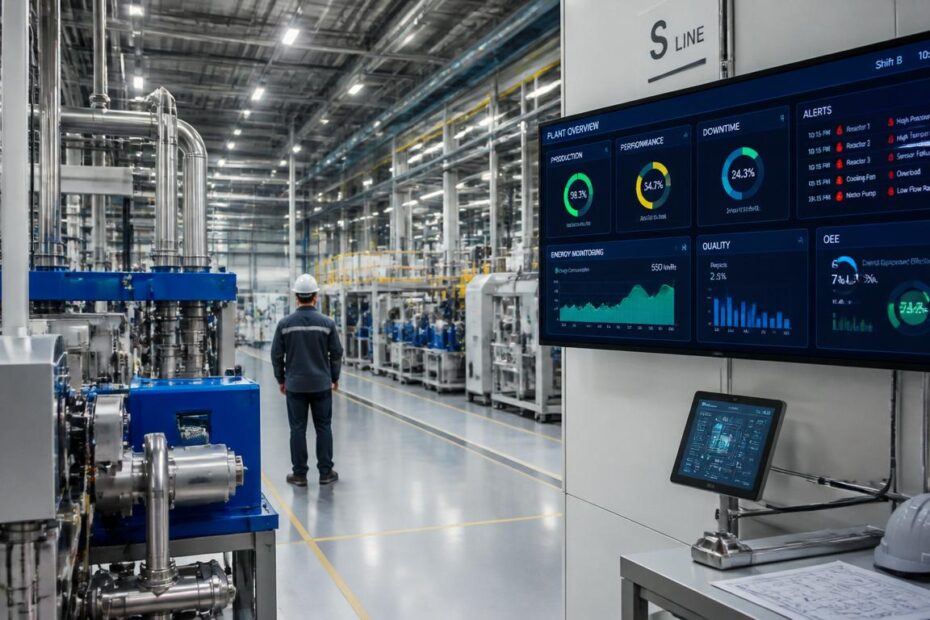
Operational Framework to Reduce Unplanned Downtime in Industrial Machinery
Operational reality requires a structured governance layer that ties uptime targets directly to asset-level actions and budget allocation. This section lays out the governance constructs, the named INECO Resilience Operational Model, and the execution rules that drive measurable reduction in unplanned downtime across heterogeneous industrial estates.
Operational governance must assign clear ownership for asset reliability, tie KPIs to finance and production metrics, and enforce decision rights for repairs versus run-to-fail scenarios. The board and plant leadership must commit to asset management standards aligned with ISO 55000 and the plant’s operating expense envelope, so maintenance decisions reflect enterprise unit economics rather than incremental heuristics. The evidence suggests networks of accountable owners reduce mean time to repair by as much as 25 to 40 percent when combined with data-driven support.
Governance and KPI Architecture
A reliable KPI architecture begins with an uptime-to-cost mapping that translates equipment availability into margin impact and contractual penalties. Define coarse-grain KPIs at the site level, such as Overall Equipment Efficiency (OEE) targets and cost-per-hour-of-downtime thresholds, then link fine-grain KPIs at the asset level like MTTR, MTTF, and failure-mode-specific detection rates. Operational reality requires monthly governance reviews that reconcile maintenance backlog, spare consumption, and capital replacement cycles.
The INECO Resilience Operational Model, or I-RO Model, prescribes three governance layers: Strategic (board-level funding and policy), Tactical (site-level maintenance and spare policy), and Execution (technician assignments, shift protocols). The model assigns explicit decision thresholds for when to deploy predictive intervention, when to perform preventive maintenance, and when to approve capital replacement based on net-present value. This model anchors capital allocation and prevents inconsistent local practices that erode spare optimization and inflate downtime.
Process Standardization and Incident Protocols
Standardized incident protocols reduce cognitive overhead during failure events and compress troubleshooting time by enforcing playbooks and diagnostic trees. Create failure-mode playbooks for critical assets, codify escalation timelines, and integrate them into the digital work order system so the dispatch, parts reservation, and safety checks occur in an orchestrated sequence. Operational reality requires these protocols to be exercised quarterly under simulated failure drills to identify process gaps.
Define a two-tier incident protocol: Tier 1 addresses immediate containment and safe restart actions that site operators can perform, Tier 2 mobilizes specialized technicians and cross-site expertise. Each incident record must capture root cause analysis inputs to the I-RO Model repository so recurring failure modes produce controlled corrective plans. Strategic Takeaway: Formalize an I-RO governance layer with asset-specific decision thresholds, aiming to cut MTTR by 30 percent within 12 months.
Predictive Maintenance and Critical Spare Strategy
Predictive maintenance must deliver actionable lead times and spare requisition triggers that match real logistics realities, not theoretical detection windows. This section explains sensor selection, analytics cadence, and a critical spare policy that reduces stockouts and avoids excess inventory while shortening repair times.
Deploying predictive maintenance requires a phased approach: instrument the highest-risk assets first, validate detection models with ground truth, and integrate alerts into work order systems with SLA-driven response rules. Practical implementation pairs edge-level anomaly detection for immediate triage with cloud-based prognostics for longer-horizon failure forecasting. Operational reality acknowledges noisy data and supply variability, so predictive outputs must include confidence bounds and recommended parts reservations.
Sensor Fabric and Analytics Pipeline
Sensor selection depends on failure modes, operational environment, and the signal-to-noise profile of each machine. Vibration and current signatures identify bearing and motor issues quickly, temperature and pressure trends flag seal or hydraulic leaks, and acoustic emission can provide early fracture detection for high-speed rotating equipment. Design the analytics pipeline so local edge inference executes real-time thresholds and the cloud model aggregates longitudinal trends for remaining useful life estimates.
Analytics must output ranked interventions with estimated lead time to failure and a parts impact list so planners can reserve inventory or trigger expedited procurement. Ensure models incorporate production schedule overlays, because a predicted failure during a low-utilization window requires different action than one during peak demand. Validate detection precision and false positive rates under operational load to avoid unnecessary interventions that cost more than the downtime they prevent.
Critical Spare Strategy and Inventory Policy
A critical spare strategy must calibrate stock levels to lead times, failure probability, and the cost of downtime per hour, not simply part cost. Segment spares into three classes: mission-critical with immediate need and high downtime cost, tactical with moderate lead times and predictable use, and commodity with long lead times and low downtime impact. Use probabilistic inventory models tied to predictive outputs to convert remaining useful life into reservation and reorder signals.
Institute cross-site pooling for slow-moving high-cost spares and local caches for fast-moving consumables, enabled by integrated inventory visibility and dynamic transfer rules. Include service-level clauses with OEMs for prioritized shipping or on-site consignment for the highest-impact components. Strategic Takeaway: Adopt a probabilistic spare policy that reduces stockouts by 60 percent while decreasing carrying cost through pooling and predictive reservation.
Data Infrastructure and Asset Digital Twins
Digital twins must serve as deterministic decision engines that consolidate telemetry, maintenance history, and failure-mode logic to produce prescriptive maintenance actions. This section covers edge-cloud architecture, security and data governance, and the lifecycle management required to keep digital twins accurate under equipment change and process variation.
Design the data backbone to support both low-latency edge inference and high-fidelity historical analysis. Local gateways must perform protocol normalization, short-term pattern recognition, and enforce cybersecurity controls, while cloud services provide model retraining, fleet-level anomaly correlation, and integrated visualizations for operations teams. The architecture must respect network segmentation, industrial DMZ principles, and zero-trust models given the increased regulatory scrutiny in 2026.
Edge Computing and Network Resilience
Edge compute reduces detection latency and maintains essential monitoring when connectivity to the cloud degrades, a frequent reality during factory network outages. Place inference engines close to sensors to execute deterministic checks and trigger backup safety procedures autonomously when necessary. Network resilience requires multi-path design, local caching of critical models, and health telemetry that escalates to on-site IT when packet loss or latency exceed defined thresholds.
Implement secure firmware update channels for edge devices and validate cryptographic attestations to prevent tampering, since compromised edges can produce false positives or mask failures. Include rolling redundancy for critical nodes so a single device failure does not blind predictive capability. Operational reality demands architecture that continues to provide actionable alerts even under constrained connectivity.
Digital Twin Implementation and Model Governance
Digital twins must pair physics-informed models with data-driven corrections to produce reliable remaining useful life estimates across duty cycles. Maintain model governance that tracks model lineage, performance drift, and retraining triggers, and require explainability for field technicians so recommendations translate into effective actions. Treat each twin as a controlled artifact with versioning, test suites, and rollback procedures.
Incorporate change management: when a machine receives a retrofit or process shift, the twin must receive a corresponding configuration update before model outputs regain trust. Integrate twin outputs into the I-RO Model decision thresholds so prescriptive maintenance becomes a governed input to governance reviews. The following table compares common sensor and model options for initial instrumentation.
| Sensor Type | Detection Latency | Typical Cost per Node (USD) | Detection Precision | Typical Use Case |
|---|---|---|---|---|
| Vibration (accelerometer) | Minutes to hours | 150–350 | High for bearing faults | Motors, gearboxes |
| Motor Current Signature | Seconds to hours | 80–200 | Medium-high for electrical faults | Motors, drives |
| Temperature / IR | Minutes | 40–150 | Medium for thermal drift | Bearings, electrical panels |
| Acoustic Emission | Seconds to days | 300–600 | High for crack growth | High-speed shafts |
| Pressure / Flow | Seconds | 50–200 | High for hydraulic leaks | Pumps, valves |
Strategic Takeaway: Implement edge-first twin architecture with model governance and version control to ensure reliable prognostics and reduce false-positive interventions by 40 percent.
Workforce and Process Governance
Skilled technicians and disciplined shift turnovers remain the single largest operational lever to reduce downtime once hardware and analytics are in place. This section outlines upskilling, augmented procedures, and the human-in-the-loop design that integrates diagnostics into rapid decision making.
Invest in a competency matrix that maps technician skills to asset families and failure modes, then schedule cross-training so multi-skilled crews can respond to a broader range of events. Use augmented reality-guided procedures for complex repairs, but ensure those procedures are validated through hands-on drills and not only digital simulation. Operational reality requires redundancy in human capability across shifts and sites to avoid single-person knowledge silos.
Skills, Shift Handover, and Augmentation
Shift handovers must include concise reliability checklists and health-state snapshots for critical assets, driven by digital dashboards that summarize anomalies and pending interventions. Codify learning loops where technicians annotate model outputs, improving model labels and providing field-validated feedback. Augment technicians with decision-support tools that convert sensor signals into prioritized checklists so repairs occur in the most time-efficient sequence.
Provide continuous professional development credits tied to competency milestones and link training performance to maintenance budgets, so investments in skills show measurable returns. Reward reduction in repeat failures and improved MTTR with site-level incentives to embed reliability into daily performance metrics.
Compliance, Safety, and Change Control
Every maintenance action must satisfy safety and compliance constraints across multiple jurisdictions, and change control must include risk assessment, permit validation, and documented rollback steps. Integrate compliance checks into work orders, so required permits or confined-space authorizations block execution until resolved. Operational reality demands traceability for audits and incident investigations, connecting sensor logs, work orders, and sign-offs.
Control of process changes must include updated twin configurations, revalidated test plans, and a post-change monitoring window where model sensitivity is higher to detect unintended regressions. Strategic Takeaway: Operationalize a skills-to-asset matrix and AR-guided procedures, targeting a 20–30 percent reduction in repair cycle inefficiencies within the first year.
Supply Chain and Spare Parts Logistics
Supply chain constraints and extended lead times remain the primary external driver of protracted downtime in 2026, as nearshoring and regional capacity shifts create localized bottlenecks. This section prescribes sourcing strategies, logistics resilience and collaboration models with OEMs and 3PLs to ensure parts arrive when prognostics predict failure.
Move beyond single-supplier reliance for critical components and establish dual-sourcing with defined qualification pathways and rotational orders to keep alternate suppliers warm. Use contractual lead-time SLAs and penalty clauses where the cost of downtime justifies such terms, and maintain a small consignment pool for the most impactful spares. Operational reality requires dynamic reallocation of parts across sites based on real-time predictive signals.
Strategic Sourcing and Lead Time Hedging
Hedge lead time variability by combining local stocking of high-impact spares with regional hubs for medium-impact items, and apply probabilistic forecasting that converts remaining useful life into replenishment urgency. Negotiate vendor-managed inventory for bulky, slow-moving parts and ensure visibility through EDI or API integrations so planners get real-time fulfillment status. Factor inbound transit risk, customs clearance time, and last-mile constraints into the spare decision matrix.
Deploy scenario planning for disruption events, mapping the impact of port congestion, regional energy curtailments, and sudden demand spikes on spare availability. Establish financial reserves for expedited shipping and pre-approved budgets for emergency replacement, reducing approval time during incidents.
Vendor Collaboration and Service Agreements
Service agreements must include measurable uptime commitments, rapid-response clauses, and clear escalation matrices that include remote diagnostic access. For complex, high-value assets, prefer outcome-based contracts where vendors share part of the downtime risk and participate in reliability governance reviews. Operational reality suggests that aligning vendor incentives with uptime drives faster root cause remediation and improved spare allocation.
Create data-sharing agreements that permit vendor access to telemetry for co-managed prognostics while preserving IP and privacy through scoped data contracts. Strategic Takeaway: Combine local consignment, regional hub pooling, and vendor risk-sharing agreements to reduce average spare procurement lead time by up to 50 percent.
This briefing synthesizes governance, analytics, workforce, and supply chain levers into a compact strategic plan for executive decision making. It assumes CAPEX discipline, multi-site operations, and regulatory constraints across the EU and US markets in 2026.
Operational decisions should prioritize assets where downtime exceeds replacement thresholds, where spare lead times are long, and where prognostics provide >30 percent lead forecasting horizon. The document presumes available telemetry, a committed maintenance budget, and cross-functional governance to implement the I-RO Model.
Conclusion: How to Reduce Unplanned Downtime in Industrial Machinery
The path to materially lower unplanned downtime requires coordinated modernization of governance, sensor infrastructure, digital twins, workforce capability, and supply chain resilience under one operational framework. Reduce ambiguity by embedding the I-RO Model into governance cadences, ensure digital twins receive disciplined model governance, and align procurement terms to uptime economics. Operational reality demands measurable targets, resource commitments, and quarterly recalibration against production and financial outcomes.
Strategic takeaways emphasize three priority moves: instrument the highest-impact assets with edge-capable sensors and a twin within 12 months, implement probabilistic spare policies linked to prognostics, and operationalize technician augmentation with validated AR procedures. Each of these actions ties back to firm metrics: target a 30–40 percent reduction in MTTR, a 50 percent reduction in critical spare lead time, and a 20–30 percent fall in false-positive maintenance actions when implemented together.
Strategic Takeaways
Deploy the I-RO Model across sites, enforce asset-level KPIs that tie to margin, and fund a prioritized instrumentation program that targets assets with the highest downtime cost. Link predictive outputs to dynamic inventory reservations and vendor SLAs so parts are available when required. Train and augment crews to act on prescriptive diagnostics, and subject all changes to strict model and safety governance.
12-Month Forecast
Over the next 12 months, manufacturers will increase edge analytics adoption driven by concerns about latency and cyber risk, and regionalized supply chains will make local consignment more valuable. Carbon pricing and energy cost volatility will force operations to consider downtime not only as lost production but also as a contributor to scope 1 and scope 2 intensity. Expect tighter vendor collaboration models, more outcome-based service contracts, and accelerated consolidation of maintenance platforms into cloud ecosystems that support cross-site intelligence.
Tags: predictive-maintenance, digital-twin, spare-parts-strategy, industrial-automation, operational-governance, supply-chain-resilience, workforce-augmentation
FAQ
What is the minimum instrumentation set to achieve reliable predictive alerts for a mixed fleet of motors and pumps?
A minimal instrumentation set for motors and pumps includes a tri-axial accelerometer on bearings for vibration analysis, motor current sensors for electrical anomalies, and temperature sensors at bearings and windings; where hydraulics are present, include pressure and flow sensors. Configure edge analytics to run frequency-domain vibration signatures and current signature harmonics for immediate alerts, while cloud models aggregate trend data for remaining useful life. This set balances cost with the ability to detect >70 percent of common failure modes within meaningful lead times.
How should a mid-size multi-site manufacturer restructure spares after adopting predictive maintenance models?
Restructure spares by classifying inventory into mission-critical, tactical, and commodity tiers, then apply predictive reservation signals to mission-critical parts with probabilistic reorder points tied to remaining useful life distributions. Create regional pooling for tactical items to exploit scale and local consignment for mission-critical parts to guarantee immediate availability. Implement API-level inventory visibility across sites and vendor portals, and adjust safety stock dynamically based on forecasted failure clusters and lead-time volatility.
How do you validate digital twin outputs before acting on them in live operations?
Validate digital twin outputs by parallel-run testing where predicted alerts are compared against actual equipment performance without executing corrective actions, then measure false-positive and false-negative rates over an operational cycle. Incorporate technician feedback as labeled data, perform controlled failure injection tests where safe, and require that model recommendations include confidence intervals and a clear action ranking. Only escalate to automatic work-order generation once precision and recall metrics meet predefined reliability thresholds for each failure mode.
What contractual terms with OEMs reduce downtime risk without incurring excessive recurring costs?
Negotiate tiered service agreements that combine fixed preventive maintenance hours with outcome-based clauses tied to uptime or response times, plus options for consignment or vendor-managed inventory for the most critical spares. Include escalation clauses, defined technical ownership for remote diagnostics, and capped expedited shipping allowances to avoid ad-hoc budget overruns. Structure payments to incentivize rapid root-cause closure rather than repeated temporary fixes, aligning vendor incentives with long-term reliability improvements.
How do ESG and carbon constraints influence downtime mitigation strategies in 2026?
ESG and carbon constraints shift decision criteria by internalizing energy and emissions penalties into downtime cost calculations, making decisions that reduce unplanned stops financially preferable when restart energy or emissions exceed thresholds. This pushes firms to invest in more efficient diagnostics and preventive actions that avoid high-emission restart cycles, and to include energy-impact metrics in spare prioritization and maintenance scheduling. Regulatory reporting in multiple jurisdictions also demands traceable maintenance records and validated emissions calculations tied to downtime events.